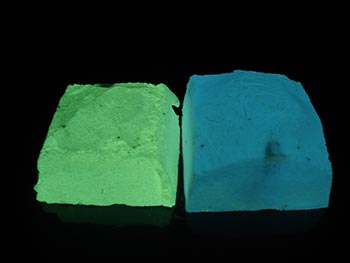
Long afterglow luminescent materials refer to materials that can store light energy after a short period of exposure to sunlight or artificial light sources and can continue to glow for a longer period of time, also known as light storage materials. Since the 1990s people in SrAl,0. On the basis of Eu3, Nd or Dy is added to develop an efficient long afterglow luminescent material that can be applied in practice. Its luminous intensity and afterglow time are several times that of traditional sulfide luminescent materials, and its afterglow is more than 10h, no radioactivity, and good heat resistance, oxidation resistance and chemical stability. Due to its unique physical properties, it has been widely used in traditional emergency lighting low-light display system and decoration and beautification, and has been widely used in many occasions such as aircraft, airports, subways, building decoration, fire fighting facilities, highways, railways, automobiles, road signs, theaters, commercial buildings, arts and crafts.
The active ions that can produce long afterglow luminescence are mainly Eu, in addition, Ce, Tb, P, Mn* plasma also has long afterglow luminescence phenomenon. Eu* mainly presents d-f wide-band transition emission in the alkaline earth aluminate system, and its emission wavelength varies with the composition and structure of the substrate, and the emission wavelength is mainly concentrated in the blue-green band. Because Eu has a strong absorption capacity in the relatively wide band from the ultraviolet to the visible region, Eu* activated materials can produce a long afterglow from blue to green under the excitation of sunlight, fluorescent lamps or incandescent lamps. The co-activator itself does not emit light in the matrix or there is a weak luminescence, but it can have an extremely important influence on the luminescence intensity of Eu, especially the afterglow lifetime. Now some effective auxiliary activators are mainly rare earth ions such as Dy, Nd’, Ho, Er, Pr, Y and La and non-rare earth ions such as Mg supplement and Zn*.
Due to the poor water resistance of aluminates, the surface of the particles needs to be physically and chemically modified, and it is difficult to prepare blue and red long-afterglow luminescent materials. Recently, silicate luminescent materials have become the focus of research, but their afterglow time and luminescent properties are still a certain gap compared with aluminates. From the present point of view, the development of rare earth ion doped silicate system long afterglow material, and then improve its long afterglow time and luminance is an important development direction of long afterglow material research.